



What “Contract Furniture” Means When You’re Furnishing a Boutique Hotel in Lagos, Abuja or Port Harcourt
If you are developing a boutique hotel in Lagos, Abuja or Port Harcourt, you have probably met the term before you needed it. A luxury contract furniture supplier is not the same thing as a furniture showroom. It is a specific kind of manufacturer, building for a specific kind of durability, and knowing the difference can save a project months of delay and a large part of its budget.
Why this matters right now
Nigeria has moved to the top of Africa’s hotel construction rankings in 2026, with over 14,000 rooms under development, more than any other country on the continent. Lagos alone carries a pipeline of roughly 4,250 rooms across 33 planned projects, and Abuja has close to 3,000 rooms in planning or construction. International arrivals to Africa rose about 8% in 2025, the strongest growth of any region, keeping pressure on developers to open well-furnished properties quickly.
Every one of those rooms, lobbies and lounges needs furniture that survives daily commercial use for years, not just on opening day. That is what “contract furniture” means.
Contract furniture versus retail furniture
The difference is in how a piece is built and tested, not how it looks.
- Retail furniture is built for a private home, where a sofa might be used for a few hours a day by the same handful of people
- Contract furniture is built to commercial specification: frames made for constant turnover, fabrics and finishes chosen for abrasion resistance and fire safety, and joinery that withstands years of housekeeping, guest use and cleaning
A developer furnishing a 60 to 120-key property needs every lobby chair, headboard and outdoor lounge piece to meet that commercial standard. That is why a hospitality furniture specification looks so different from a residential one: it sets out durability, fire safety and material requirements alongside the design intent.
The materials that hold up under commercial use
Commercial-grade furniture starts with materials that were built to last. West Africa’s furniture tradition offers some of the most durable hardwoods anywhere, and naming them gives a project team something concrete for the procurement file.
Hardwoods suited to contract use
- Iroko (African teak), naturally decay-resistant and well suited to indoor lounges and covered outdoor areas
- Sapele, dense and richly grained, related to true mahogany and strong enough for frames that see daily use
- Afzelia (Doussié), very dense and termite-resistant, often specified for high-traffic case goods and reception furniture
- Opepe (Bilinga), valued for its strength and resistance to warping
- African mahogany, used where a warmer, more traditional finish suits the lobby or suites
Upholstery and finishes suited to hospitality use
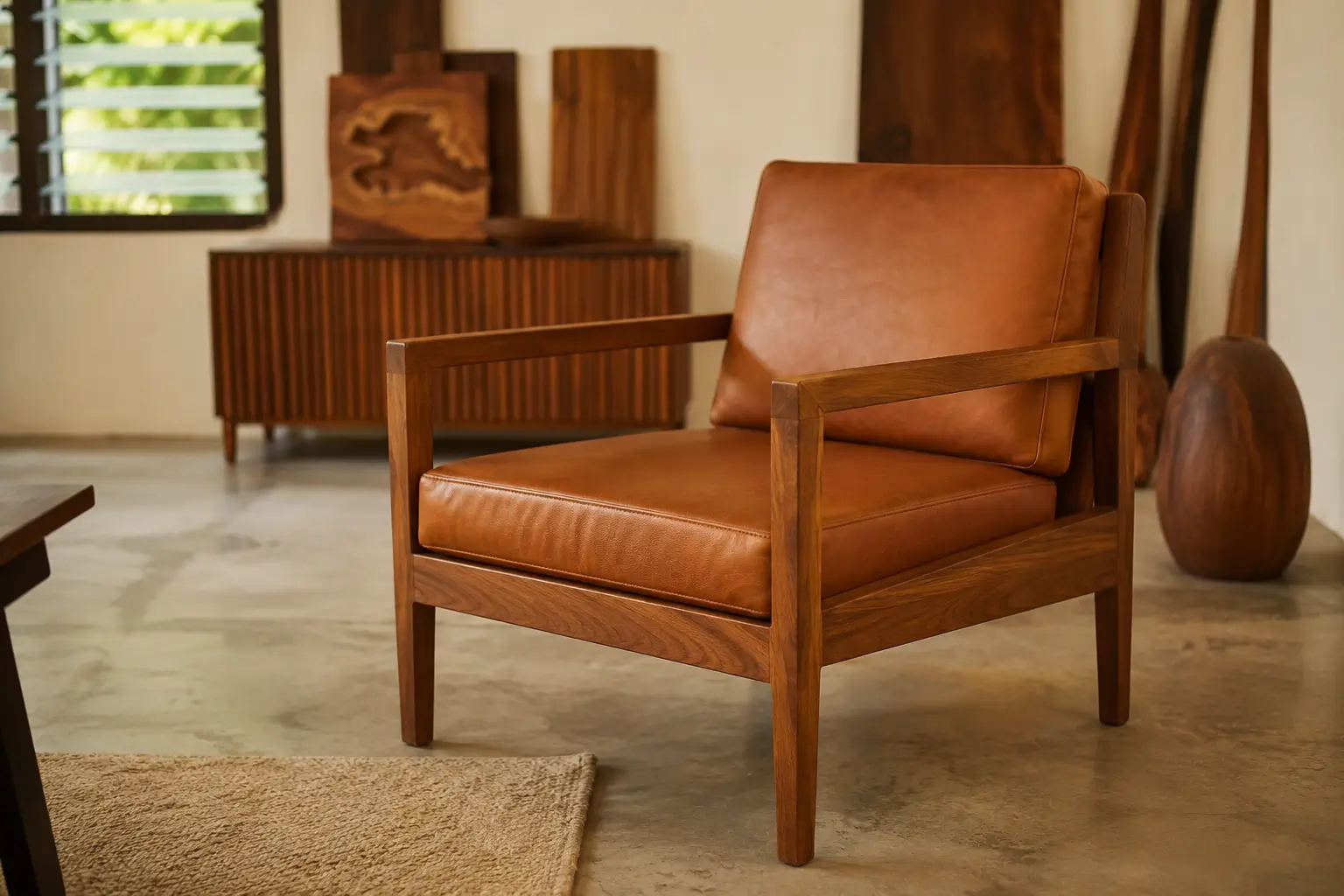
- Commercial-grade leathers, full-grain and top-grain, specified to the fire-safety standard your market requires
- Performance fabrics in bouclé, linen blends and mohair, chosen for abrasion resistance
- Handwoven West African textiles, including Aso-oke, as accent upholstery on feature seating
- Natural cane and rattan for lighter lounge and outdoor pieces, with finishes suited to the climate
- Brass and bronze hardware, hand-finished for a residential feel in a commercial setting
Writing “Sapele frame, commercial-grade leather” instead of a generic description gives an FF&E consultant exactly what the bill of quantities needs, and tells a supplier the brief is commercial, not residential.
Developing or operating a hotel? The Majeurs Trade Program gives hospitality teams tiered trade pricing, priority production and a dedicated project contact. Apply for trade access.
A working example
Picture a 90-key boutique hotel opening in Victoria Island, Lagos, one of the busiest parts of the city’s hotel pipeline. The brief calls for lobby seating that handles constant turnover, guest room case goods that survive years of housekeeping, and rooftop bar furniture exposed to Lagos humidity.
A supplier working to contract standard would typically:
- Confirm the durability and fire-safety requirements for each furniture category before quoting
- Recommend Sapele or Iroko frames for high-use pieces, paired with suitable commercial upholstery
- Provide finish samples that account for humidity and coastal exposure, especially for outdoor pieces
- Plan lead times around the construction and fit-out schedule, not just production time
The approach is the same in Lagos, Abuja, Port Harcourt, London or California. What changes is freight, customs and local fire-code compliance, all of which should be confirmed early.
Questions to ask before you commit
- Can the supplier provide fire-safety and abrasion documentation for upholstery?
- Are their frames built for high-traffic hospitality use?
- Have they furnished hospitality spaces before, and can they show the work?
- What is their capacity for a multi-room order on a construction-linked timeline?
- What warranty and aftercare come with the order?
A supplier who answers with documentation rather than reassurance is one who understands what “contract” means.

Why hotel developers join the Majeurs Trade Program
- Tiered trade pricing: 5% from ₦10M, 12–15% from ₦25M and 15–20% from ₦50M in cumulative annual spend, so multi-room orders can unlock the higher tiers
- One accountable contact from quotation to installation, with production planned around your programme
- Made to your spec: custom dimensions, materials and finishes, with samples and prototypes before full production
- On-site measurement and installation support
- Aftercare: a 1-year structural warranty on custom furniture, plus optional maintenance packages for serviced and short-let properties
Working with Majeurs
Majeurs builds hospitality furniture from Iroko, Sapele, Afzelia and African mahogany, with hand-finished upholstery and detailing, for developers and operators furnishing boutique hotels, lounges and members’ clubs across Lagos, Abuja, Port Harcourt and beyond. Our GAIA Africa lounge in Lagos is one example.
THE MAJEURS TRADE PROGRAM
Furnishing a hotel in Nigeria, or taking the same standard abroad?
Join the Majeurs Trade Program for tiered trade pricing, priority production and a dedicated contact for your project.
